
TradFi Perpetual Arbitrage
How Crypto Carry Extends to Stocks, ETFs and Commodities
By Joey Shi · 1Token / 1ndex Research
Executive Summary
This research by 1Token and 1ndex examines how institutional managers are applying crypto funding-rate and basis-arbitrage strategies to tokenised stocks, ETFs, commodities and other TradFi-linked perpetual markets.
Drawing on 1ndex market data and contributions from nine institutional strategy teams, the article compares TradFi-linked and crypto funding opportunities, implementation models and key cross-venue risks.
For managers and investors evaluating TradFi perpetual arbitrage, 1Token provides the portfolio management, risk, P&L and reconciliation infrastructure needed to consolidate exposures across crypto exchanges, DeFi protocols and traditional brokers, while 1ndex helps investors discover, analyse and connect with relevant digital-asset strategies and managers.
From Crypto Carry to TradFi Perpetual Arbitrage
Crypto funding-rate arbitrage is increasingly crowded. BTC, ETH and large-cap altcoin books no longer offer the easy returns they once did. A neighbouring opportunity emerged as crypto venues began listing TradFi-linked perpetual contracts. Binance and Bitget expanded stock-perp products, while Hyperliquid’s HIP-3 framework enabled builder-deployed non-crypto perps. These venues created a practical short leg for a trade that previously lacked one: short an equity-, ETF- or commodity-linked perp, collect funding, and hedge with the real asset at a broker, a CEX-based stock instrument, or an on-chain route.
The mechanism resembles conventional crypto carry, but the market structure is different. Shorting the perp is usually the easy part. Building and maintaining the long hedge across a broker, CEX or on-chain venue creates the friction—and much of the premium. The relevant questions are therefore not only how much funding the perp pays, but where the hedge sits, how collateral moves, and which leg can fail first.
Crypto carry is the baseline
Crypto delta-neutral strategies remain the reference point for carry-based arbitrage. In the 1ndex Delta Neutral universe, a filtered basket that excludes obvious long-short and prop-style strategies while retaining cross-venue arbitrage returned 6.1% over the 181 days from 15 January to 15 July 2026. That is approximately 12.7% on a compounded annualised basis, with a maximum drawdown of 0.28%. The constituent pool now includes more than 20 strategies. It is a mature and scalable market, but one in which a durable edge is harder to find.
Managers trading TradFi-linked perpetual arbitrage strategies report higher headline expectations. A small set of manager-reported targets falls in the 15–25% annualised range, depending on venue structure and leverage, while early reported drawdowns remain below 1%. These figures are indicative rather than a seasoned benchmark: the sample is small, track records are measured in weeks, and the operational risks have not been tested through a full market cycle. TradFi perpetual arbitrage does not need to outperform crypto carry on every metric; it needs to show that the additional funding compensates for its additional complexity.
The funding signal
Using a fixed mainstream basket instead of a top-volume screen gives a cleaner comparison. From 20 June to 10 July 2026, the venue-average robust mean funding rate for mainstream crypto perps across Binance, Bitget, OKX and Hyperliquid was approximately 2.8% annualised. The comparable TradFi-linked figure was approximately 12.6%. This does not mean that every TradFi-linked contract offers better carry than every crypto contract. The narrower conclusion is that, after controlling for a consistent mainstream candidate universe, TradFi-linked perps displayed a visible funding premium across multiple venues.
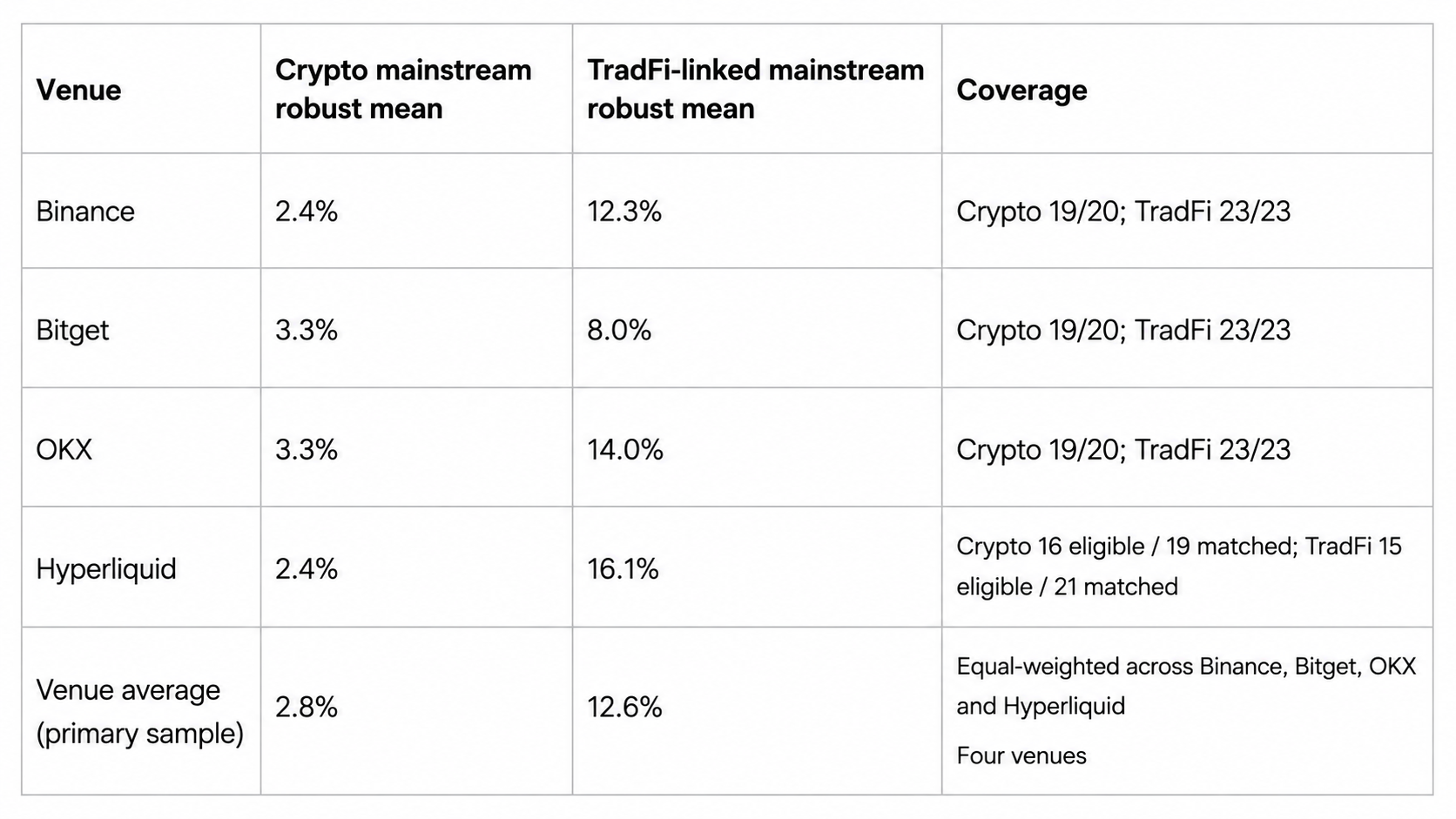
Source: Binance Futures funding history API, Bitget history funding rate API, OKX funding-rate-history API and Hyperliquid info/fundingHistory. Window: 20 June–10 July 2026. Venue-level robust means are winsorised at the 5th and 95th percentiles and annualised before fees, financing, slippage and basis P&L.
Unlike BTC or ETH funding arbitrage, where spot and perp often sit on the same exchange, the corresponding hedge may sit at a broker, in a CEX-based stock instrument, or on-chain. The funding premium compensates for this cross-system work, not for the short position alone. Consider an illustrative trade: a manager shorts $10 million of an NVDA-linked perp and buys $10 million of NVDA at Interactive Brokers. If gross funding is 12%, broker financing costs 2%, execution and rebalancing consume 1%, and idle collateral costs 1.5%, net carry is about 7.5% before basis P&L and stress losses. These are assumptions, not a universal fee schedule, but they show how gross yield is consumed.
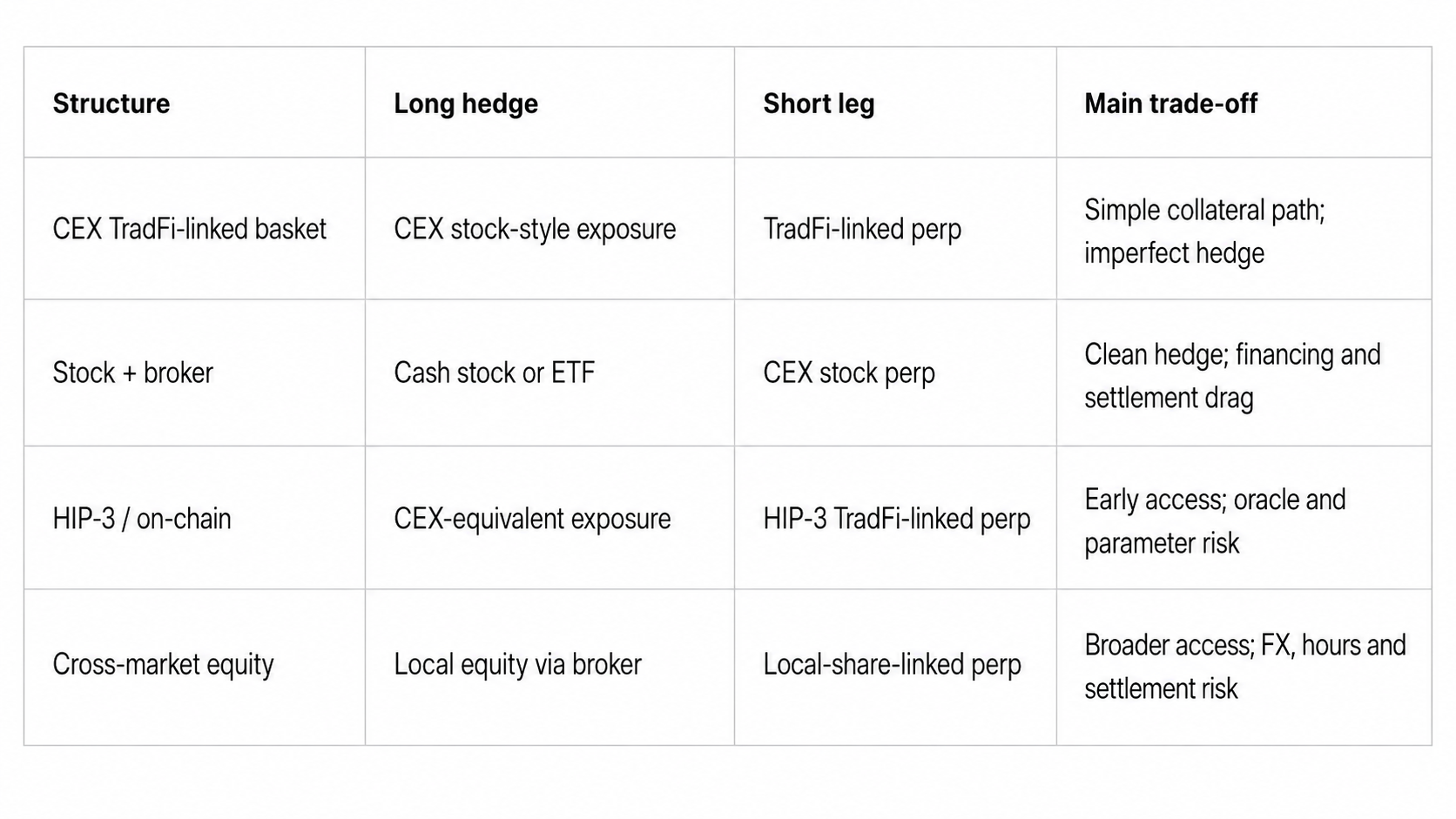
Four implementation structures
A recent example is SK hynix. Its Nasdaq-listed American Depositary Shares (ADSs, commonly called ADRs) began trading in July 2026, with each ADS representing one-tenth of a Korea-listed common share. This can produce three related but non-identical prices: the Korean share, the US ADS, and a crypto perp that references the Korean listing. Temporary gaps may emerge because the venues use different currencies, trading hours, liquidity pools and reference prices. Yet the spread is not free money. Conversion and settlement constraints can slow convergence, while the perp hedge continues to incur funding and basis risk. The opportunity depends on knowing exactly which instrument the contract tracks and whether capital can move before the gap closes.
Capacity is usually constrained by the perp leg rather than the hedge. Stock-linked perps carry far less depth and open interest than the underlying equities. A manager may be able to buy substantial cash equity without moving the market, yet be unable to build or unwind the perp leg at the displayed price. Position limits should therefore be based on stressed perp depth, not headline turnover.
For investors, the practical question is where the trade crosses systems. A CEX-native structure may rebalance quickly and use collateral efficiently, but its stock-style instrument can diverge from the cash equity. A broker hedge is closer to the underlying and may support greater capacity, but it introduces financing, settlement and transfer delays. Operational simplicity and hedge quality cannot always be maximised together. The gross funding rate shows what the perp earns; the venue map, financing assumptions and collateral policy show what the investor is likely to keep.
The risk that matters
The central risk is not that the portfolio ceases to be delta-neutral on paper. It is that one leg can break before the other can move. Stock-linked perps have thinner books than BTC or ETH. When the underlying gaps on earnings or macro news, the perp may overshoot as liquidations clear into shallow liquidity. Meanwhile, the cash hedge may become less liquid or temporarily unavailable outside regular market hours, even as the perp continues trading. The portfolio can remain flat in aggregate and still lose because the loss appears in the wrong account first.
Suppose the $10 million NVDA short-perp position is hedged with $10 million of NVDA at Interactive Brokers. NVIDIA reports after the close and the stock rises 15%. The broker leg gains roughly $1.5 million, but that gain is not immediately available as margin on the crypto venue. The perp account shows a $1.5 million loss and may face an even larger mark if perp liquidity thins. If it cannot absorb the move, the short can be liquidated, leaving the manager long NVDA without the hedge.
The response is operational discipline. Managers size positions against stressed depth, keep cross-venue leverage around 1–2x, and pre-position collateral where losses are likely to appear. Around earnings, weekends and major macro events, they reduce exposure or add temporary hedges. These choices lower gross carry, but they keep the trade alive. For investors, the key diligence question is not whether the portfolio looks neutral in a spreadsheet; it is where the trade can break and whether both legs can be reduced under stress.
That diligence should cover the perp’s index and oracle, liquidation mechanics, funding calculation, weekend policy, broker permissions, FX exposure and the manager’s transfer procedures. It should also distinguish realised results from target returns and ask how much of the reported yield survives financing, slippage and idle collateral. A strategy can be directionally sound yet unattractive after these costs, or profitable in normal markets while carrying a concentrated failure mode around a single venue or event window.
Bottom line
TradFi perpetual arbitrage currently offers a credible source of near-term alpha, with funding premiums above those available in mainstream crypto perps. But it is execution-dependent alpha, not passive carry. Fragmented liquidity, collateral separation, basis differences and asynchronous trading hours can consume the premium or cause one leg to fail. Investors should focus less on the headline funding rate and more on whether a manager can retain net carry through disciplined instrument selection, conservative leverage, pre-positioned collateral and credible cross-venue risk management.
Participating Strategy Teams
The following manager profiles are provided for informational purposes and do not represent a ranking or endorsement
GrandLine Technologies
Established in 2018, GrandLine Technologies is a systematic multi-strategy trading firm specialising in mid-frequency, market-neutral strategies across major digital assets on both centralised and decentralised exchanges. With seven years of live track records, the firm is recognised for its research and risk-management processes and has received industry recognition from Hedgeweek and HFM.
Its TradFi-linked basis strategy targets pricing and financing dislocations between tokenised real-world assets and their underlying instruments across crypto-native and traditional markets. Currently focused on tokenised equities and commodities, the strategy systematically pairs offsetting positions to capture funding-rate differentials and temporary basis spreads. By maintaining a market-neutral portfolio, it seeks to generate consistent relative-value returns while remaining largely independent of broader market direction.
LuxTech Capital Group
Founded in 2018 by fund managers with domestic and international backgrounds, LuxTech Capital Group specialises in quantitative digital-asset management. Its shareholders and team members come from traditional asset management and have collectively managed more than RMB 10 billion. The research team includes master’s and doctoral graduates from the University of Illinois Urbana-Champaign, Tsinghua University and Shanghai Jiao Tong University, with prior experience in core quantitative roles at Akuna Capital and Citadel.
LuxTech runs a market-neutral arbitrage strategy in which spot and perpetual exposures are hedged within a single exchange, reducing execution friction and cross-venue operational risk. The strategy targets basis mispricing when tokenised-stock spot and perpetual products are newly listed, as well as elevated funding yields during bullish periods. It typically goes long tokenised-stock spot instruments, such as Binance b-stocks, while shorting corresponding perpetuals. Maker rebates provide an additional source of return, without taking directional exposure to the underlying equities.
Pythagoras Investments
Pythagoras Investments is a crypto-focused quantitative hedge fund whose multidisciplinary team includes quantitative traders, researchers, computer scientists, risk managers and portfolio managers. Sixty percent of the team graduated from Ivy League institutions, while 20% hold PhDs in quantitative disciplines.
The firm reports an 11.5-year track record, described in a PwC report as the longest verified record among crypto quantitative strategies. Its systematic approach has operated across market regimes including the 2022 crypto winter and the 2024 bull market. Pythagoras has been featured by Bloomberg during both periods and has received several industry awards, including Best Crypto Fund of the Year.
The firm has extended its established quantitative strategies into tokenised stocks and equity-linked perpetuals, using cross-exchange, statistical and funding-rate arbitrage within a unified market-neutral risk framework.
ForthTech
Founded in 2021, ForthTech is a digital-asset manager specialising in systematic quantitative and multi-strategy investing. Its team draws experience from quantitative funds, digital-asset exchanges, global investment banks and technology companies.
Its market-neutral framework integrates traditional securities, tokenised assets and digital-asset derivatives across brokers and crypto venues. Using automated execution and portfolio-level risk controls, it targets structured arbitrage, basis, funding-rate and cross-market relative-value opportunities rather than directional market movements.
Since launching in June 2024, the fund reports a cumulative return of 43.05%, including 6.27% in 2026 YTD, with a maximum drawdown of 0.66% and a Sharpe ratio of 7.56. Performance is independently calculated and recorded by third-party fund administrators and tracked on 1ndex.
HashRock
HashRock runs a market-neutral strategy integrating crypto assets and tokenised stocks within a unified risk framework. Led by Jean Felipe Menegazzo, Ayron Ferreira and Pablo Renan, the team specialises in structured arbitrage, systematic allocation and multi-venue execution.
The strategy dynamically allocates exposure across traditional brokers and crypto venues according to pricing, liquidity, spreads and funding conditions. It targets basis discrepancies between tokenised stocks and their underlying equities, alongside spread and funding differentials between tokenised stocks and perpetual contracts. In doing so, HashRock applies established crypto-market techniques—including cash-and-carry arbitrage and funding-rate capture—to equity-linked instruments.
Since inception in March 2024, the fund has returned 61.16%, including 7.42% YTD, with a 4.19% maximum drawdown and a 3.59 Sharpe ratio. Performance is tracked on 1ndex.
WSS
WSS operates mature delta-neutral strategies whose core algorithms have been continuously refined and market-tested since 2024. Its six-member team comprises senior professionals, each with more than five years of industry experience.
The WSS Cross-Exchange TradFi strategy systematically captures differences in trading mechanisms, pricing and funding rates across crypto-native and traditional-market venues. Using TradFi-linked perpetual contracts and offsetting positions, it constructs a market-neutral portfolio designed to harvest cross-market basis and funding opportunities. The strategy combines disciplined execution with strict downside controls, seeking stable relative-value returns while limiting exposure to broader market direction.
Stakestone
Stakestone runs a market-neutral strategy that combines crypto and tokenised equities within a unified risk framework. The team specialises in structured arbitrage and systematic capital allocation.
By monitoring prices, liquidity, spreads and funding conditions, the strategy targets funding-rate dislocations between tokenised equities and perpetual contracts, applying crypto-native arbitrage techniques to equity-linked markets without relying on directional exposure.
Since inception in 2019, the fund reports a cumulative return of 206%, including 8.73% in 2026 YTD, with a maximum drawdown of 0.6% and a Sharpe ratio of 8. Performance is tracked by 1ndex.
Yohalpha Capital
Yohalpha Capital specialises in mid- to high-frequency systematic trading, combining prediction-enhanced delta-neutral strategies with disciplined execution and risk management. With more than three years of live trading experience, including its pre-incorporation track record, the team focuses on delta-neutral portfolio construction, predictive modelling and low-latency execution.
Its framework dynamically reallocates capital across native crypto assets, tokenised equities and commodity-linked contracts. It targets opportunities arising from market microstructure, oracle dynamics, basis relationships, funding dislocations and cross-asset pricing inefficiencies. A market-neutral foundation is supplemented by vectorised forecasts of direction, volatility and other market factors, allowing the strategy to enhance returns selectively while maintaining controlled exposure.
The firm reports annualised returns of approximately 15–20% for its core delta-neutral strategy and around 30% for its prediction-enhanced framework. Its live production track record has maintained annual returns above 15%, with maximum drawdown below 0.75%.
JZL Capital
JZL Capital specialises in market-neutral strategies, systematic trading and high-frequency execution. Since 2022, the firm has focused on developing low-drawdown relative-value strategies across digital-asset markets.
More recently, JZL has expanded its research into tokenised equities and TradFi perpetuals, examining the pricing relationships among tokenised spot instruments, equity-linked perpetuals, oracle feeds and their underlying traditional-market shares. The team also models funding rates to identify and allocate capital toward attractive carry opportunities.
Building on this research, JZL has developed an enhanced single-exchange market-neutral framework integrating crypto-native and equity-linked assets. The firm reports that adding equity-linked instruments has improved the returns of its conventional single-exchange arbitrage strategy by approximately 20%, while maintaining a comparable risk and drawdown profile. Since 2022, JZL reports annual returns above 10%, with maximum drawdown below 0.5%.
About 1Token / 1ndex
1Token is a global technology provider for digital-asset investment managers, with operations across APAC, Europe and North America. The company supports more than US$20 billion in assets across over 100 institutional clients and holds SOC 2 Type I and Type II certifications.
Its award-winning Crypto Asset Management (CAM) system connects with CeFi and DeFi venues through APIs, bringing portfolio management, trading, risk control, fund operations and reporting into a single environment. The platform supports front-office teams with live positions, exposures and performance analytics; middle-office teams with portfolio operations, risk monitoring, shadow NAV and investor activity; and back-office teams with trade reconciliation, valuation and P&L reporting.
1ndex complements this infrastructure as 1Token’s research and data platform for tracking, analysing and evaluating digital-asset investment strategies.
For business enquiries, strategy-manager participation or investor collaboration, please contact:
Joey Shi: joey.shi@1tokentech.com
Gloria Yao: gloria.yao@1tokentech.com
Sources and data notes
Public data accessed 12–13 July 2026. Funding data came from official Binance, Bitget, OKX and Hyperliquid APIs and public snapshots. Product rules, contract parameters and tradeable symbols may change. Other references include 1Token and 1ndex materials, Binance and Bitget stock-perp guides, Hyperliquid funding/HIP-3/ADL documentation, Interactive Brokers market-access material, Nasdaq trading hours, SEC settlement guidance and the SK hynix SEC filing.
Selected references
• Binance Academy — How to Trade Stock Perpetual Contracts on Binance
• Bitget — Traditional Asset Perpetual Futures Overview
• Hyperliquid — HIP-3: Builder-Deployed Perpetuals
• Hyperliquid — Perpetuals API and Funding History• Interactive Brokers — Margin Rates and Financing
• Nasdaq — U.S. Trading Hours and Holiday Schedule
• U.S. SEC — Shortening the Securities Transaction Settlement Cycle
• U.S. SEC — SK hynix Form F-6 Registration Statement
Disclaimer
This article is for market education only. It is not investment, legal or tax advice, nor an offer, solicitation, ranking or endorsement of any strategy, manager, venue or product. Funding, liquidity, leverage, product rules and availability may change. Readers should independently verify the information and assess suitability, counterparty, legal and operational risks.
Comments ()