
Beyond Manager Selection: Building an Institutional Investment Platform for Digital Assets
How Annamite Capital combines specialist quantitative talent, systematic investment underwriting, institutional prime brokerage, and continuous risk oversight.
Introduction: Due Diligence as a Continuous Process
Digital asset markets offer an expanding range of sophisticated quantitative strategies, yet institutional access remains fragmented. Unlike traditional finance, where established multi-manager platforms have spent decades developing the infrastructure to evaluate and oversee specialist investment teams, digital asset managers operate across disparate trading venues, jurisdictions, liquidity environments, and technology stacks.
Annamite Capital was established to bridge this gap. The firm operates an institutional multi-manager SMA platform that identifies specialist quantitative talent, independently underwrites trading strategies, deploys capital according to risk-adjusted opportunity, and continuously evaluates whether each manager continues to perform in line with the original investment thesis.
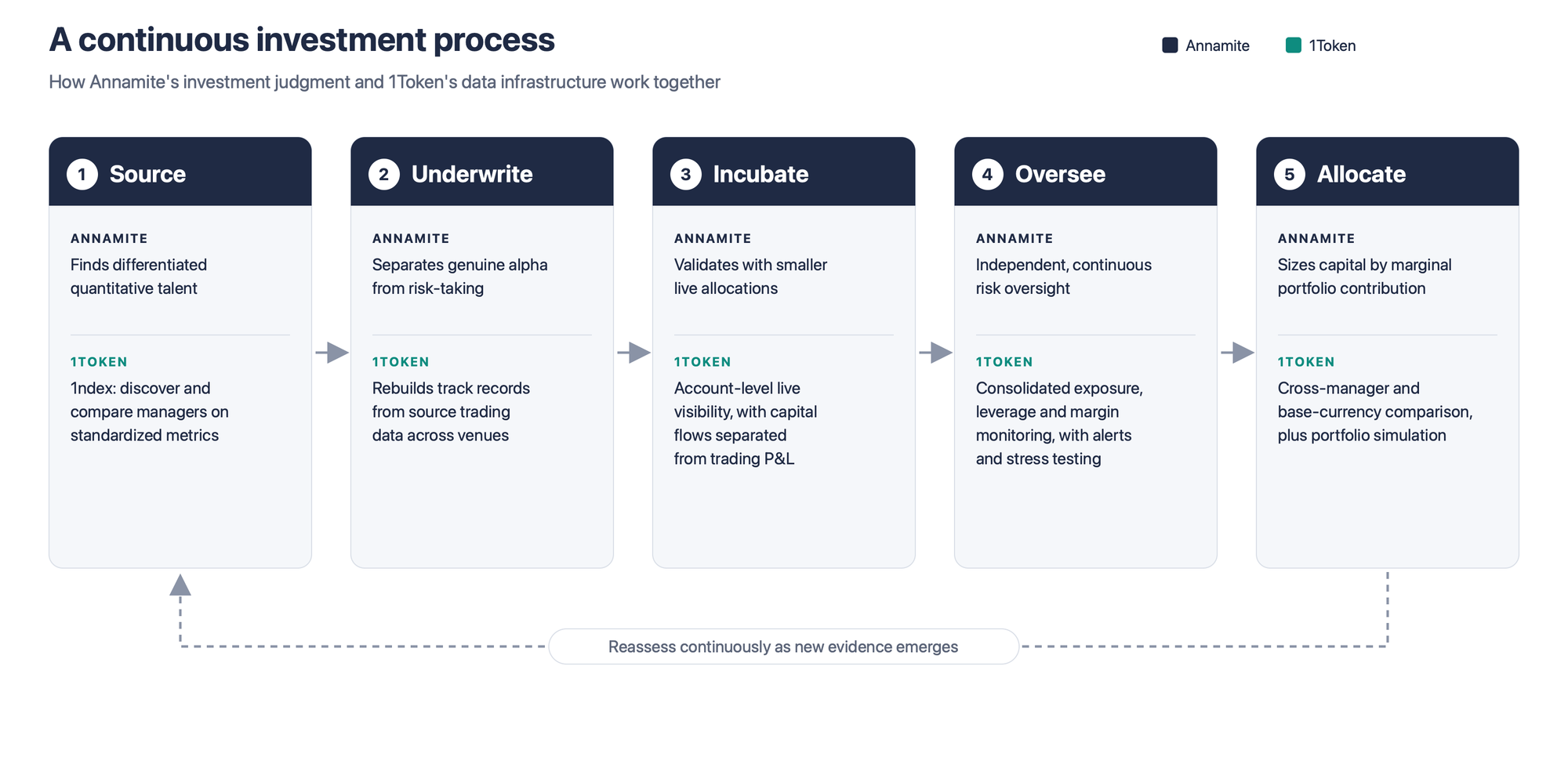
This process extends well beyond conventional manager selection. Annamite combines quantitative research, operational and strategy underwriting, live trading observation, portfolio construction, and independent risk oversight. Rather than treating due diligence as a one-time decision, the firm approaches it as a continuous cycle of sourcing managers, validating how returns are generated, observing strategies under real market conditions, allocating capital, and reassessing exposures as new evidence emerges.
1Token provides the data and portfolio infrastructure supporting this investment process. Through 1ndex, Annamite can discover and compare specialist digital asset managers; through read-only data connections, it can analyze performance based on validated source trading records; and through consolidated portfolio reporting, it can monitor positions, P&L, and risk exposures across managers and venues. Together, Annamite’s investment judgment and 1Token’s data infrastructure create a systematic foundation for accessing and overseeing diversified quantitative digital asset strategies.
Sourcing: Identifying Differentiated Quantitative Talent
For an institutional allocator, the challenge is not simply identifying managers with attractive historical returns. It is finding teams with genuine, repeatable sources of alpha, differentiated trading capabilities, sufficient strategy capacity, and complementary portfolio characteristics.
Annamite sources managers through a combination of global quantitative trading networks, direct industry relationships, exchange and prime brokerage relationships, systematic screening, and technology-enabled research. The opportunity set spans strategies including statistical arbitrage, high- and mid-frequency trading, market making, systematic trend following, mean reversion, and cross-venue arbitrage.
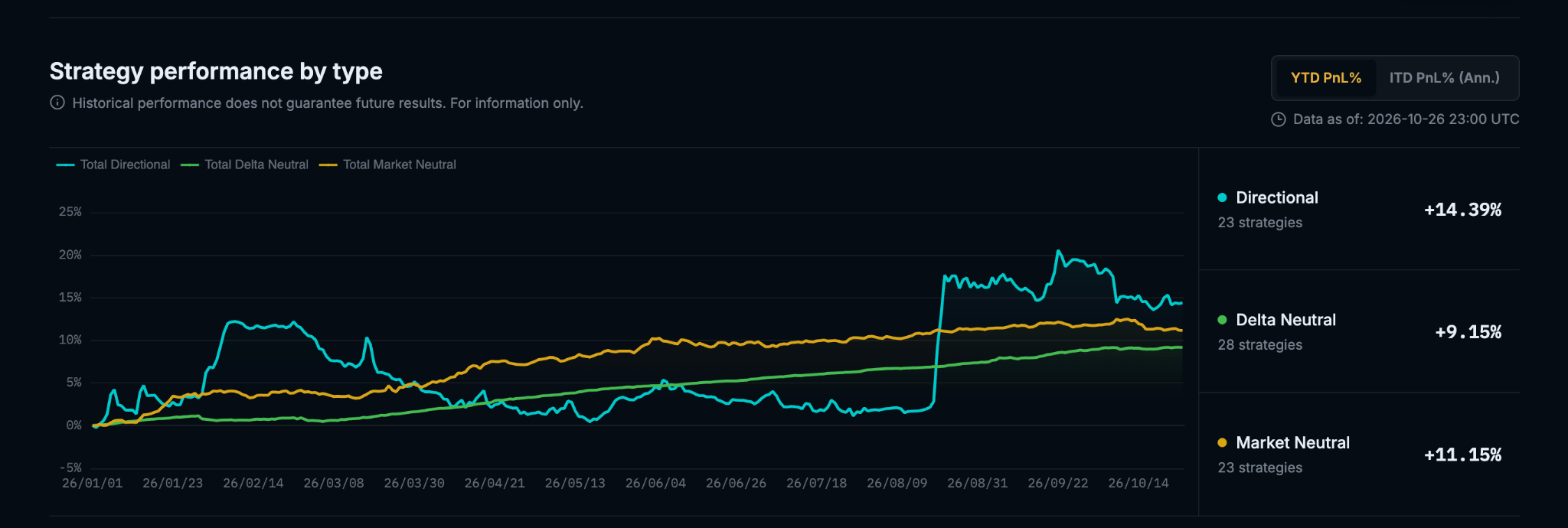
To broaden and structure this sourcing process, Annamite uses 1ndex, developed by 1Token, to identify and compare specialist digital asset trading managers across delta-neutral, market-neutral, and directional strategies. The platform incorporates standardized information on performance, volatility, drawdowns, Sharpe ratios, strategy characteristics, capacity, trading venues, and operational infrastructure, helping the investment team identify relevant managers and prioritize candidates for deeper due diligence.
Where API-connected trading data is available, these metrics are calculated on the same basis across managers, which makes comparison at the screening stage more meaningful and helps determine which managers warrant further investigation.
The information available through 1ndex and 1Token supports manager discovery and initial comparison, but it does not replace investment judgment. Annamite’s subsequent assessment considers the underlying return drivers, potential strategy crowding, execution dependencies, capacity constraints, factor exposures, and correlation with existing allocations. These deeper considerations help determine whether a manager is not only attractive on a standalone basis, but also relevant to the broader portfolio.
The objective is not to assemble a collection of individually successful traders. It is to build a pipeline of differentiated strategies that merit deeper underwriting and may ultimately contribute complementary sources of return to the overall portfolio.
Underwriting: Distinguishing Alpha from Risk-Taking
Historical returns are an incomplete measure of a quantitative strategy’s investment merit: two managers reporting similar returns and Sharpe ratios may employ fundamentally different methodologies. Annamite’s underwriting process is designed to deconstruct reported performance and identify the underlying economic sources of return.
This involves assessing whether historical profitability reflects genuine trading alpha or compensation for exposures that may be difficult to sustain, such as directional beta, short-volatility positioning, liquidity provision during stressed markets, concentrated factor bets, or excessive leverage. Annamite also examines the mechanics of the strategy, including turnover, holding periods, execution costs, slippage, funding costs, margin utilization, liquidation sensitivity, and the relationship between theoretical and realized capacity.
1Token provides the cross-asset data infrastructure supporting this analysis. Through read-only API connections and other supported data integrations, the platform consolidates investment records across CeFi exchanges, custodians, on-chain wallets, TradFi brokers, and prediction markets, scaling to hundreds of accounts and adding new venues as managers move into them. This allows allocators to evaluate strategies that operate across different markets and asset classes on a like-for-like basis. Historical positions, transactions, balances, funding and financing costs, and realized and unrealized P&L can then be reconstructed and analyzed using standardized methodologies and in different base currencies, giving the investment team an independently rebuilt track record to test against the manager’s own reporting.
Using this underlying data, Annamite can examine whether realized performance is consistent with the manager’s stated strategy. P&L attribution and exposure analysis help the investment team assess whether returns were driven by the intended trading process, directional market exposure, leverage, concentration, or a small number of outsized positions. Standardized calculations also provide a more consistent basis for comparing managers operating across different strategies and trading venues.
The quantitative record is only one part of the assessment. Annamite also evaluates the people and systems behind the strategy, including the team’s research methodology, software engineering capabilities, operational discipline, and ability to adapt to changing market structures. Particular attention is paid to drawdown behavior, return asymmetry, tail-risk exposure, stability across market regimes, and the reliability of the underlying trading infrastructure.
The ultimate question is not whether a manager has generated attractive historical returns, but whether the process behind them can be understood, independently validated and expected to remain economically viable as capital scales.
Incubating: Building Conviction Through Live Trading
One of the most important distinctions between historical due diligence and institutional capital allocation is the ability to observe a strategy operating with real capital, in real market conditions.
Annamite employs a measured capital deployment process, beginning with smaller allocations designed to validate a manager's trading behavior, execution quality, operational reliability, and adherence to predefined risk parameters.
Once a manager progresses to live trading, 1Token provides continuous, account-level visibility into performance, positions, exposures, leverage, and trading activity across connected venues, while subscriptions, redemptions and transfers are tracked against each strategy’s principal so that capital movements are separated from trading P&L. This allows Annamite to compare backtested and simulated results with realized trading performance, while gaining insight into strategy capacity, market impact, execution slippage, and the effects of different volatility and liquidity environments.
Importantly, the process is not simply about waiting for a positive return.
A manager can generate positive P&L while violating the underlying investment thesis. Equally, a manager may experience short-term losses while behaving entirely consistently with the expected strategy. The ability to distinguish between these outcomes is central to Annamite's allocation discipline.
Live observations are incorporated into an evolving investment assessment, helping determine whether a strategy should receive additional capital, remain under observation, undergo further review, or be discontinued. The objective is to replace assumptions with evidence before committing capital at institutional scale.
Monitoring: Independent Risk Management
In a multi-manager quantitative portfolio, investment risk cannot be evaluated solely at the individual strategy level. Managers with different trading methodologies may share common exposures to liquidity, volatility, momentum, exchange infrastructure, collateral, or market structure.
Annamite's risk framework is designed to provide independent, continuous oversight of both individual trading strategies and the aggregate portfolio. This includes monitoring realized and unrealized P&L, gross and net exposures, leverage, concentration, margin utilization, liquidation thresholds, counterparty exposures, and changes in strategy behavior.
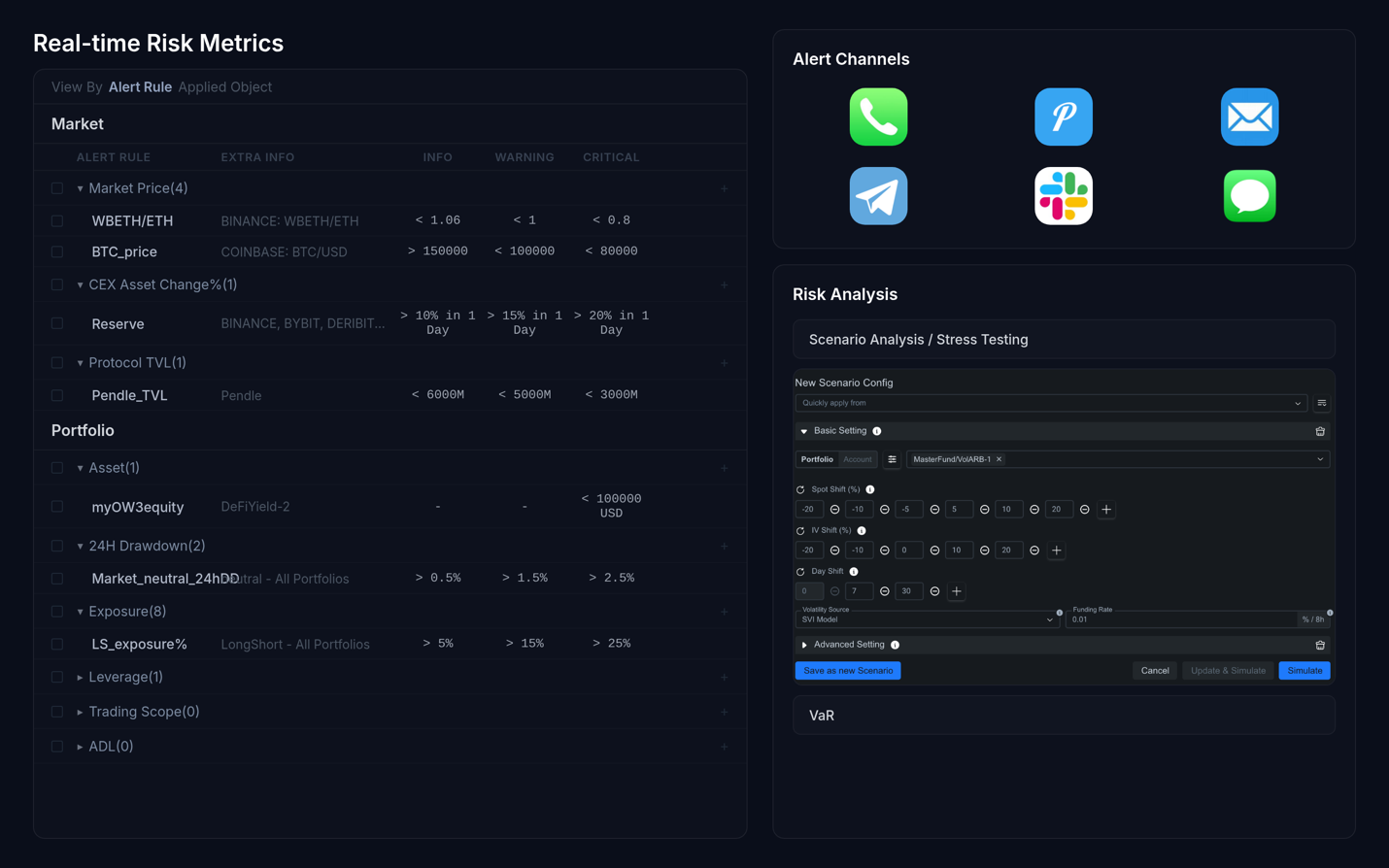
To support this framework, 1Token consolidates risk data across managers, exchanges, custodians and other connected venues into a single portfolio-level view, with live alerts, stress testing and risk analytics to flag emerging risks and breaches of predefined limits.
A critical component is distinguishing the risks that managers intend to take from those that arise unintentionally through execution, funding, collateral requirements, or changing market conditions. The firm also evaluates portfolio-level interactions, including correlated losses, shared factor exposures, common venue dependencies, and the possibility that historically independent strategies become correlated during periods of market stress.
By combining Annamite’s independent risk judgment with 1Token’s consolidated data and monitoring infrastructure, the firm can move beyond periodic manager reviews and respond as portfolio evidence changes. Risk management is therefore not limited to enforcing static limits; it involves understanding how strategies behave, identifying changes in their underlying risk characteristics, and reallocating capital when necessary.
Allocating: Portfolio Construction and Capacity
The ability to identify attractive quantitative trading strategies does not automatically translate into an attractive multi-manager portfolio. The allocation decision requires assessing how each strategy contributes to expected portfolio returns, volatility, drawdowns, liquidity, and diversification, while accounting for the capital required to implement the strategy.
Annamite's portfolio construction process seeks to allocate capital toward strategies with attractive risk-adjusted returns, differentiated return drivers, and sufficient capacity to absorb additional investment without materially eroding their underlying edge. Allocation decisions are informed by both standalone strategy quality and marginal portfolio contribution.
1Token supports this process through performance reporting, cross-manager comparisons and portfolio simulation. Before reallocating capital, Annamite can model the effect of adding or removing a manager, or increasing and reducing individual allocation weights, and assess how those changes would have affected portfolio returns, volatility, drawdowns, correlations, concentration, and overall risk-adjusted performance. Combined with exposure monitoring and capital-efficiency analysis, these simulations help determine whether a proposed allocation improves portfolio diversification or simply adds more of an existing risk.
A strategy with an attractive standalone Sharpe ratio may deserve a smaller allocation if it duplicates existing exposures. Conversely, a strategy with a more modest standalone return profile may have substantial portfolio value if its returns are sufficiently differentiated from the rest of the book.
Capital efficiency is also central to the process. Gross exposure, margin requirements, financing costs, collateral mobility, and the ability to net exposures across venues can materially influence the economic attractiveness of a strategy.
Annamite seeks to optimize the return generated per unit of portfolio risk and capital employed, rather than simply maximizing gross returns at the manager level.
Institutional Infrastructure: Prime Brokerage, Custody and SMA Solutions
Institutional access to quantitative digital asset strategies requires robust infrastructure spanning custody, prime brokerage, financing, collateral management, and risk oversight.
Annamite has developed an institutional operating framework through its relationship with Ripple Prime (formerly Hidden Road), enabling access to multiple trading venues, efficient capital deployment, and consolidated risk management.
For institutional investors, Annamite can offer customized separately managed account (SMA) structures, including potential tri-party custody arrangements with BNY Mellon, direct collateral posting to Ripple Prime, and the use of RLUSD where supported. These structures provide flexibility around custody, collateral, and financing while maintaining transparency and independent oversight.
This infrastructure allows institutional allocators to access Annamite's specialist quantitative strategies through custody and financing structures they already recognize.
ATLAS — Technology and AI-Driven Investment Oversight
Annamite is developing ATLAS (Annamite Technology, Learning and AI Systems), a proprietary AI-enabled platform designed to enhance manager sourcing, quantitative research, investment due diligence, portfolio construction, risk monitoring, and operational efficiency.
By integrating trading data, investment research, and portfolio analytics, ATLAS aims to automate routine analysis, identify emerging risks and changes in manager behavior, and enable more proactive investment oversight. That analysis draws on the reconciled data 1Token provides underneath — positions, transactions and P&L calculations across venues, available through a documented API — so that AI-driven insights are grounded in the same verified numbers the investment team relies on.
The objective is to combine institutional investment expertise with AI-driven intelligence, allowing Annamite to evaluate more strategies, make better-informed allocation decisions, and scale its platform efficiently without compromising risk oversight.
Conclusion: Institutional Access Without Rebuilding the Infrastructure
As digital asset markets mature, institutional investors have a growing opportunity to access differentiated sources of quantitative alpha beyond traditional directional exposure.
Annamite Capital provides an integrated investment platform combining specialist manager sourcing, rigorous strategy underwriting, portfolio construction, continuous risk oversight, and institutional trading infrastructure.
1Token provides the independent data infrastructure underneath that process, consolidating positions, transactions and P&L across exchanges, custodians and other venues, and calculating performance and risk on a consistent, verifiable basis from first screening through to final allocation.
Together, Annamite's investment platform and 1Token's data infrastructure, supported by Ripple Prime's prime brokerage and Annamite's proprietary ATLAS technology, enable institutional allocators to access and scale diversified quantitative digital asset strategies without building the underlying investment and operational infrastructure in-house.
Comments ()